- How does the airport operate?
- Your Area
- What are we doing?
- Additional Information and FAQs
Site Contents Page


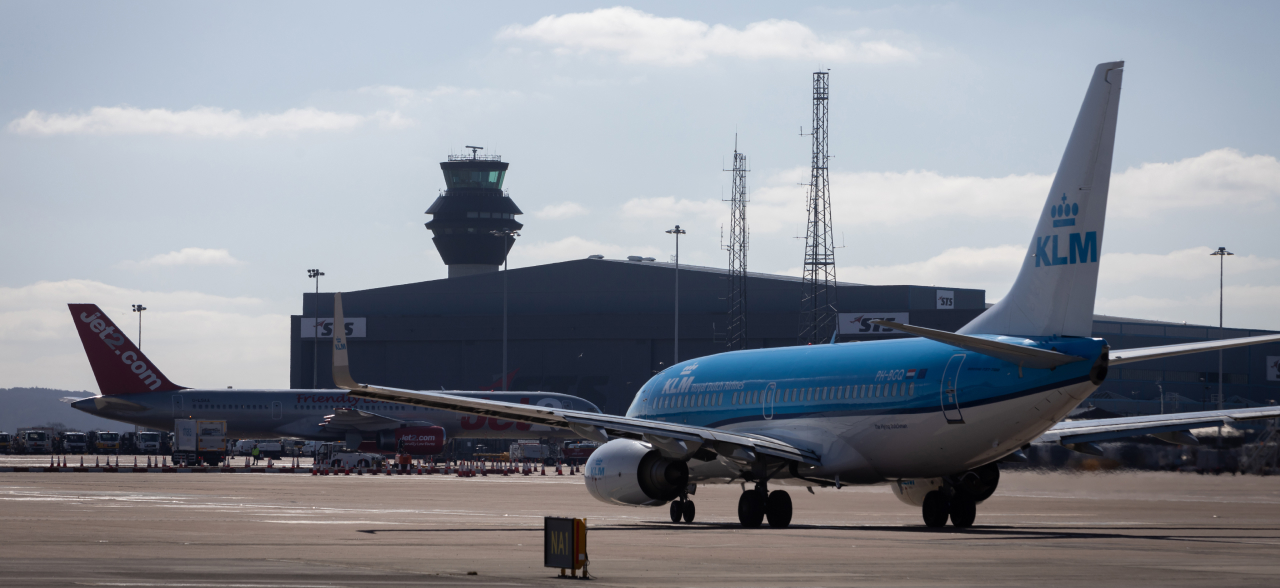
To ensure a safe take-off and landing, aircraft depart and arrive into the wind. On take-off, this helps produce the lift required to get airborne and landing into the wind enables a slower speed over the ground. The weather and wind direction can change and therefore the direction that the aircraft are arriving and departing may change to ensure the safest conditions to operate.
Air Traffic Control manages the runway direction for the safest aircraft operations. This includes consideration of the wind at ground level, 1000ft, and 2000ft, as well as the forecasted weather. Local weather forecasts only display wind strength and direction at ground level and this can differ at higher altitudes. Therefore local weather forecasts are not always a reliable indicator of the likely direction that aircraft will be operating.
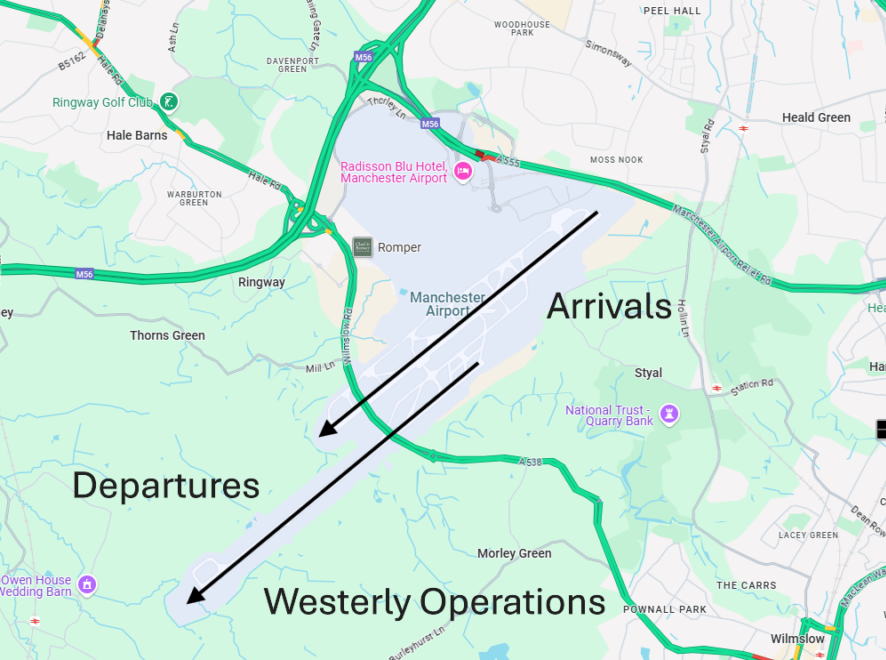
When the wind is blowing from west to east, the airport will operate in a westerly direction, known as “westerly operations” and the reverse during “easterly operations”. Experience of operations at Manchester Airport shows an average of over 80% of operations, each year, are westerly and the remaining operations in an easterly direction. The 80/20% split is an annual average and there are months with a much higher/lower proportion of westerly/easterly operations. An image demonstrating the direction of operations can be seen below:

Flight paths for arriving aircraft follow broadly similar patterns, unlike departures which are much more defined. The flight paths ensure separation from other air traffic and avoidance of adverse weather when necessary. This means that there may be variation in airport arrivals at different times of the day.
Aircraft arriving into Manchester Airport are transferred from the NATS area control centre to the Air Traffic Control approach controller, who sequences aircraft into an arrival pattern. They are then instructed where to fly by the Air Traffic Controllers, where they are directed towards their final approach before landing. When established on final approach to Manchester Airport, aircraft are transferred from the approach controller to the tower controller before landing.
To minimise the noise of approaching aircraft for communities near arrival paths, a ‘Continuous Descent Approach’ (CDA) is used when possible. Instead of a traditional descent whereby the aircraft reduces altitude in a stepped manner (similar to walking downstairs), they glide at a more constant rate (like an escalator). This keeps aircraft at a higher altitude for longer, minimising noise for local residents before an aircraft joins the ILS (the red shaded area in the image below), as well as providing benefits for fuel efficiency and reducing emissions. Operating a CDA is not always possible due to several factors such as congested airspace or adverse weather conditions which need to be avoided. With the Manchester Future Airspace project, we plan to facilitate changes that will make CDA easier to deliver. You can find out more about arrivals at Manchester Airport in the following video.

Departing aircraft move on the ground from their parking stands to the runway using taxiways. At the runway, they then await clearance from Air Traffic Control (ATC) to take-off. The weight of a departing aircraft can vary due to the amount of fuel, passengers, luggage, or cargo, and there can be a difference in the noise generated as the aircraft accelerates along the runway to become airborne.
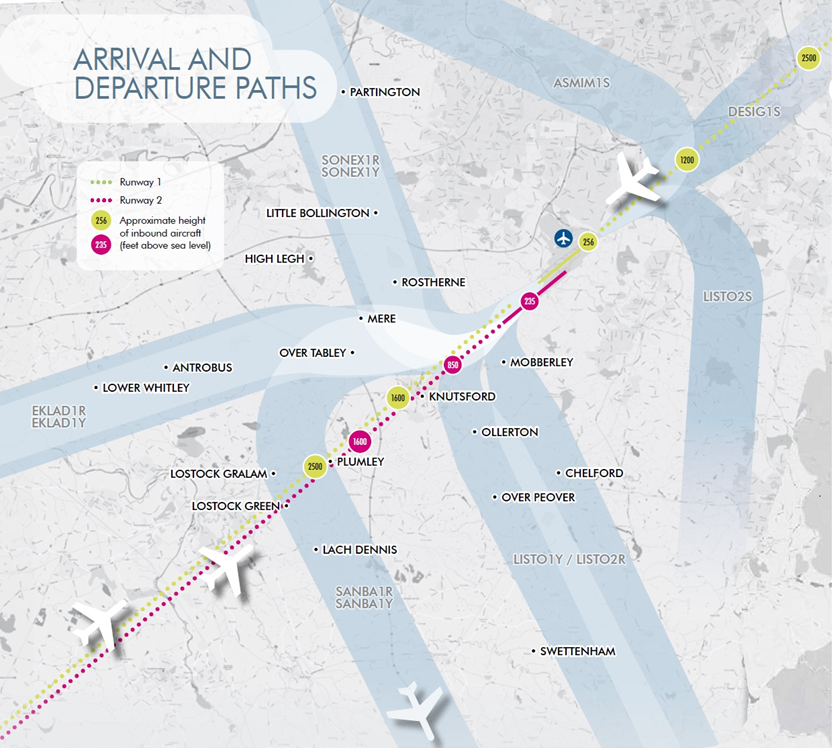
Depending on the aircraft’s destination, the departure will fly one of a number of departure routes (known as Noise Preferential Routes or NPRs). These routes are flown to minimise the overflight of local communities, whilst ensuring separation with other departures and surrounding air traffic, as well as optimising routing to the destination. The NPRs can be seen below. You can find out more about Manchester Airport Departures in the video above.

Aircraft must remain within the NPR until they reach a minimum altitude of between 3,000 to 5,000ft depending on the route, after which ATC can provide a more direct routing to the destination. For safety reasons, ATC may sometimes provide instruction to an aircraft to exit the NPR earlier to avoid adverse weather or other air traffic.

The International Civil Aviation Organisation (ICAO) has developed the concept of a ”balanced approach” to aircraft noise management. This approach incorporates four key elements to the mitigation of noise levels at airports, which has been endorsed under the EU Directive 598/2014. This aligns with the UK Government policy on aviation noise, which can be found here.
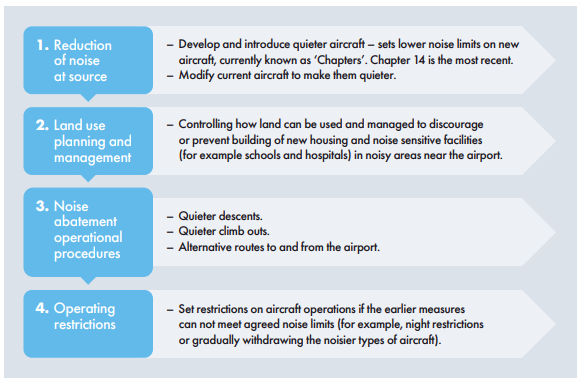
Knowing where aircraft fly and how well they are complying with airport noise mitigation rules helps everyone to improve operations and keep the noise exposure to the absolute minimum. The airport is acknowledged as a noisy place, but steps can be taken to abate that noise as much as possible. Our noise strategy can be viewed here.
| Period Name | Time | Noise Limit |
| Night | 23:30-06:00 | 81 dB |
| Shoulder | 23:00-23:30 & 06:00-07:00 | 82 dB |
| Day | 07:00-23:00 | 90 dB |
Money raised from noisy aircraft penalties is donated to the Manchester Airport Community Fund.
The Airport’s Noise and Operations Monitoring System (ANOMS) is configured to analyse compliance with all of these procedures, providing data and analytics to airport staff. This data can be extremely useful to determine trends, identify non-compliant performance, and could inform future planning such as to engage directly with the airline to improve overall performance.
An example of a Continuous Descent Approach:
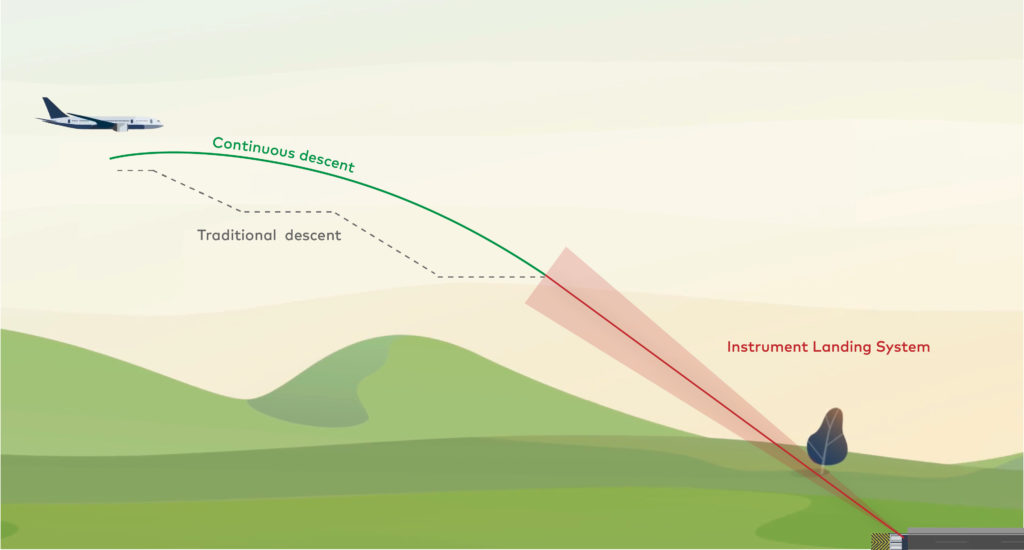
Below is a video which explains the Continuous Descent Approach procedure:

You can easily determine if an aircraft is overflying your area by looking at the tail. If you can see the tail, the chances are the aircraft is too far away from you to be counted in our statistics. The following two videos explain how you can determine overflight and how our system calculates location-specific data used on this website.
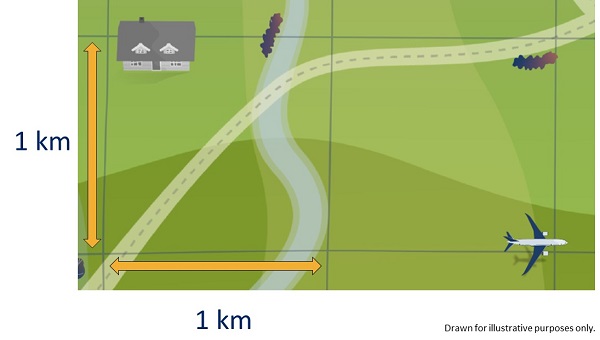
To be able to analyse the number of flights over an area around the airport, we have created a grid of identically sized, 1 kilometre by 1 kilometre squares. In total, the grid extends for 40nm (nautical miles) around the runway, ranging from certain identified towns and landmarks. 40nm is approximately the extent of our radar coverage and the data in our noise and track keeping system (ANOMS).
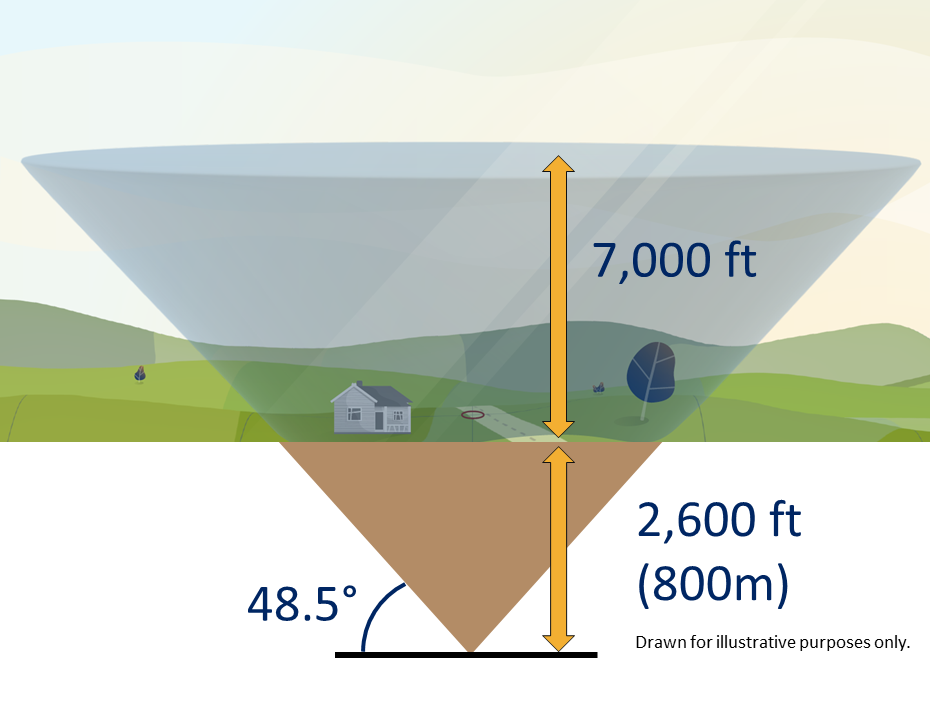
We start by drawing a cone in the corner of each grid. Using the location that you provided when you entered the site, we determine the nearest cone to you.
Flights that pass through each cone are recorded and that data is presented on this website.
To ensure we capture as much overflight data as possible and to fully cover all locations in our grid, we have lowered the cone by 2,600 feet (800 metres) into the ground. This is to ensure that all locations within the 1km grid are captured by the cone that extends above. The cone extends up to 7,000 feet (2.1 kilometres) above local ground level and at the very top, the cone is over 5 kilometres wide. This is for indicative purposes only and therefore differs from the CAA methodology for calculating overflight, as used in support of the Manchester Airport airspace change proposal.
We use a cone at a 48.5 degree angle because research undertaken by the UK Civil Aviation Authority (CAA) identified that a cone best aligns with how we determine if an aircraft has overflown a location or not.
The 48.5 degree angle of the cone was selected as it incorporates an evaluation of noise, in that if one aircraft flew directly above the observer, followed by a second aircraft off to the side along the 48.5 degree line, the second aircraft would be 3 decibels quieter than the first.
All data used in our system comes directly from our Aircraft Noise and Operations Monitoring System (ANOMS), which receives flight data from Air Traffic Control radar.
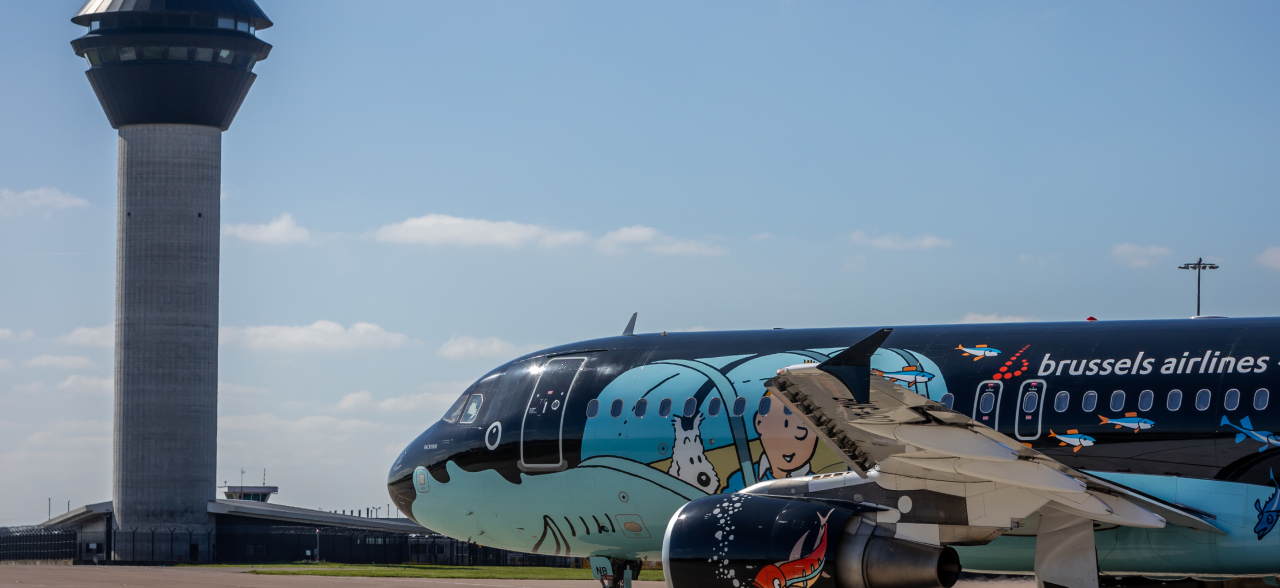
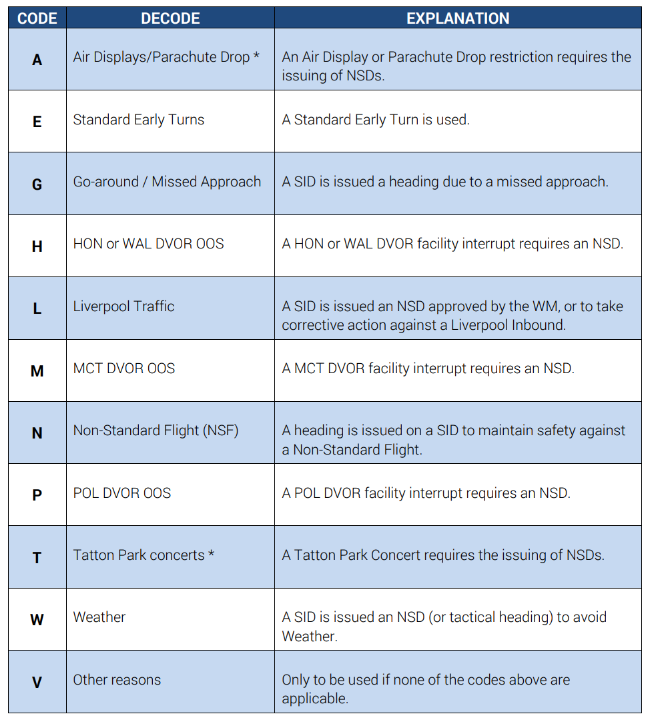
NSDs are special, alternative instructions given to aircraft by Air Traffic Control, which usually instruct an operator to fly outside the published noise preferential routes. These instructions are usually given prior to take off but can sometimes be given once the aircraft has left the runway. The reason for NSDs can vary as shown below, however NSDs will only be implemented when deemed necessary to maintain safe operations.
Possible reasons for NSDs:
Below is an example of an NSD due to weather from the 23L runway:

Below is an example of a departing aircraft following the EKLAD1Y off the 23L runway:
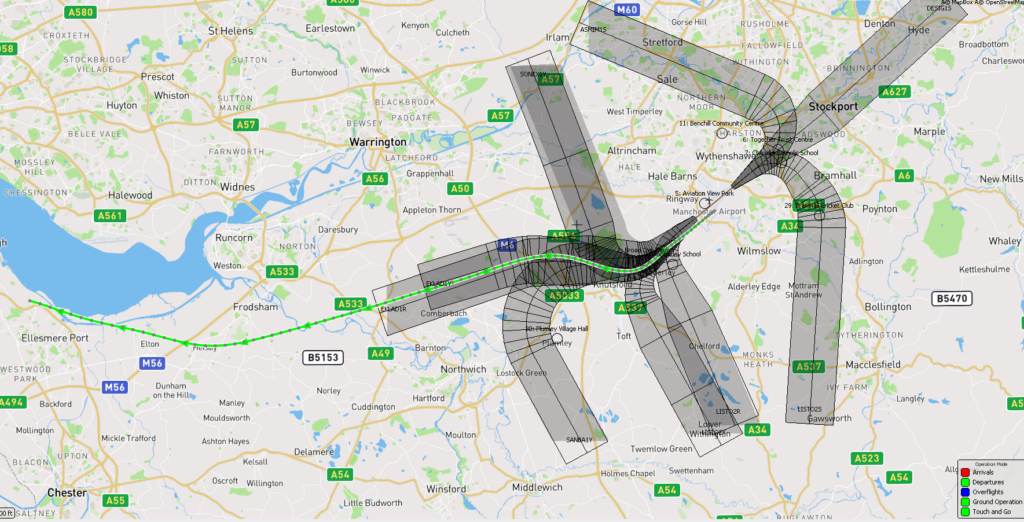
You can find out more by watching this video:
Runway 1 is closest to the terminal buildings. When we are using a single runway, aircraft land and depart from Runway 1. Air traffic control issue instructions so that only one aircraft is on the runway at a time. To create a more efficient operation, aircraft can be positioned on a nearby ‘taxiway’ waiting to enter the runway once the previous aircraft has either departed or has vacated the runway after landing.
Manchester Airport has two runways. Between 2001 and 2020 both runways were used during the daytime. Our planning permission does not allow us to use Runway 2 between 10pm and 6am, unless we are undertaking maintenance on Runway 1 or there is an emergency.
When we use Runway 1 and Runway 2, air traffic control use one runway for arrivals and the other for departures. This makes it simpler for air traffic control to manage arrivals and departures, and reduces delays in the air and on the ground.
Dual Runway Operation timetable for a typical winter period:
| Days | From the 1st November |
| Monday to Friday | 06:30-11:00 and 16:00-20:00 |
| Saturday | 06:30-11:00 |
| Sunday | 16:00-20:00 |
Dual Runway Operation timetable for a typical summer period:
| Days | From the 1st April |
| Monday to Friday | 06:15-20:00 |
| Saturday | 06:15-16:00 |
| Sunday | 06:15-09:30 and13:00-20:00 |
Reasons for the use of Runway 2 between 22:00 to 05:59
You can find out more by watching this video:
Noise from aircraft is generated from both the engines and the airframe, and examples of each are detailed below:
Aircraft produce the most noise during take-off, when the engines are producing the most power and thrust to accelerate the aircraft down the runway. When an aircraft is on approach, it is slowing down to land and hence the engines will be producing less thrust and therefore less noise. Airframe noise will be more apparent during this phase of flight. Different aircraft will produce different noise levels depending on the size and weight of the aircraft and the engine type fitted.
Aircraft noise experienced on the ground can vary depending on a number of factors including:
Whilst these factors influence how noticeable noise is from an aircraft, our local surroundings can also influence how much, or how little aircraft noise we experience.
For example, if you live in a noisy area, potentially within a town or city, or close to a road, the background noise level from those sources is likely to mask the sound of aircraft noise. Conversely, in a quiet area the masking effect isn’t as present and the same aircraft is likely to be more noticeable.
It is important to note that annoyance is a personal experience, what might be annoying to one person may not be annoying to another. Despite this, the airport takes noise monitoring seriously and has an active program to monitor analyse and report on the aircraft and background noise level in the local community.
Modern aircraft produce far less noise than older aircraft, producing around 90% less noise than the aircraft which were operating in the 1960s. We are seeing a continual transition to more modern quieter aircraft, with the Boeing 737-800 passenger aircraft being replaced with the Boeing 737-8200 Max. This is also apparent with Cargo operators, with new Boeing 777’s replacing older Boeing 747’s.
Take a look at our Noise Level Dashboard under the ‘Your Area’ heading to see how noise is recorded at our monitors.

This dashboard provides information about how regular and frequent flights are in your area as well as their altitude.
We also include information about what kind of aircraft they are by aircraft category. Where appropriate, overflights from other airports are shown.
There are many different classifications of different aircraft types. Examples of aircraft that fall under each category are:
Please note this is not an exhaustive list. Further aircraft information can be found here.
If you have changed your location, please refresh your web browser.

Whilst this portal and our flight tracking tools have been setup to help you investigate noise concerns yourself, we recognise that not all of your questions will be answered and are happy to take questions, enquiries or if you would like to make a complaint about an aircraft that caused a disturbance.
We provide an online tool (WebTrak) that enables you to see air traffic in the vicinity of Manchester Airport. View WebTrak here.
You can also submit a noise complaint directly through our WebTrak system.
You can also submit questions, enquiries and complaints to us via a number of methods including:
You can report aircraft disturbance by filling out our online Noise Complaint Form, by emailing community.relations@manchesterairport.co.uk or by using our automated complaint line on 08000 967 967.
If you wish to write to us directly, our address is:
Flight Evaluation Unit
Olympic House
Manchester Airport
Manchester
M90 1QX
Once received, the airport will investigate your submission and respond in accordance with the established procedure.

We are proud of the role Manchester Airport plays as a catalyst for the national and regional economy, helping drive tourism and cargo as well as and supporting jobs and business opportunities.
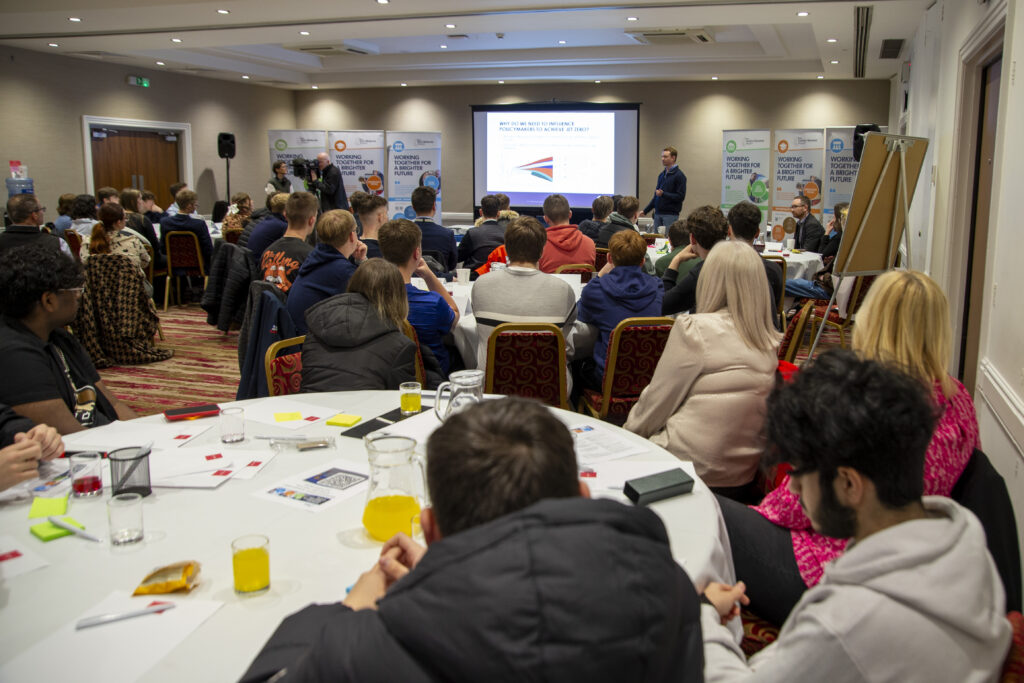
Working with our neighbours, local communities, colleagues, customers and on-site businesses is an important part of our approach to noise management.
We have a long-term commitment to make a positive difference to the quality of life in our local community. As part this commitment, we are dedicated to building and sustaining a positive dialogue with our neighbours: informing, involving, consulting and reporting back to them.
These groups include:
We regularly arrange and attend community outreach sessions where members of the public can come and talk to us about any issues or concerns they may have. These face-to-face outreach sessions take place each year in villages near to the airport. The events we will be attending are promoted on our website- here Community Outreach Events | Manchester Airport as well as social media channels. Our attendance at events is also shared by stakeholders in the community.
The MAN Community Flyer is our quarterly e-newsletter, updating you on the initiatives we are committed to within our CSR Strategy – Creating a Sustainable future for all.
You can find our latest Community Flyer issues here-Community | Manchester Airport and you can sign up to receive our quarterly Community Flyer directly to your email address here.
Additional community engagement is undertaken through:
A key part of our engagement program is this portal, which seeks to share information on our past and current operations transparently with the public. It is designed to be tailored to your local area to present detailed, localised information, as well as outline programs that engage and collaborate with the public on wider topics in their area.
You can get involved in a number of ways:
Copyright 2026. Manchester Airport plc. All Rights Reserved.
Powered by Ideagen