- How does the airport operate?
- Your Area
- What are we doing?
- Additional Information and FAQs
Site Contents Page

Behind the Scenes: Understanding Airport Operations and Aircraft Activity
Welcome to the Manchester Airport Noise Information Portal. This portal provides information about how the airport operates, how we manage noise, and how many flights operate close to your location. The portal also offers informational videos, general information, as well as visualisations of a typical day at the airport and dashboards containing data relevant to your location.
When you first enter the site, you will be asked to enter your location. You can do this by entering your address or dropping a pin on a map and pressing ‘Continue’.
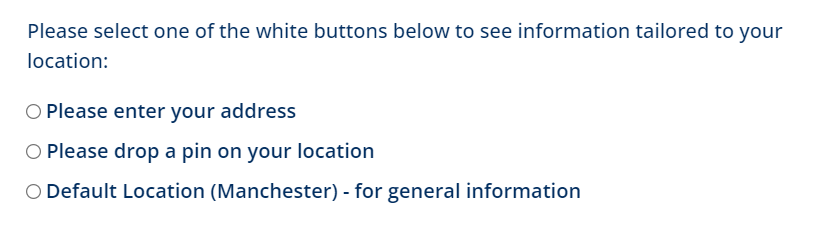
Once you have entered your location, the pages under the heading “Your Area” will automatically update and tailor the information to be specific to your location. These pages provide detail about flights in your vicinity such as the frequency and height of aircraft for different time periods of the day. This data is generated from our highly accurate Aircraft Noise and Operations Monitoring System (ANOMS) that tracks all aircraft within 40 Nautical Miles of airport. You can change your location at any time using the “select location” button in the top right corner.
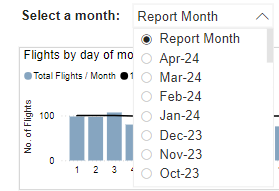
A number of pages contain interactive dashboards. Data is updated in the middle of the month, to then show the most recent full calendar month in this portal. The dashboards first load with the most recent months data, but you can change the month selected by using the drop down menu.
To view the dashboard as a full screen, there is a button on the top right corner of the dashboard called “View Fullscreen”. Pressing ‘ESC’ on your keyboard will exit the full screen display.
You can navigate through each page in order via the next button at the bottom of the page. You can also return to the main menu via the ‘back to menu’ button which will take you back to the home page.
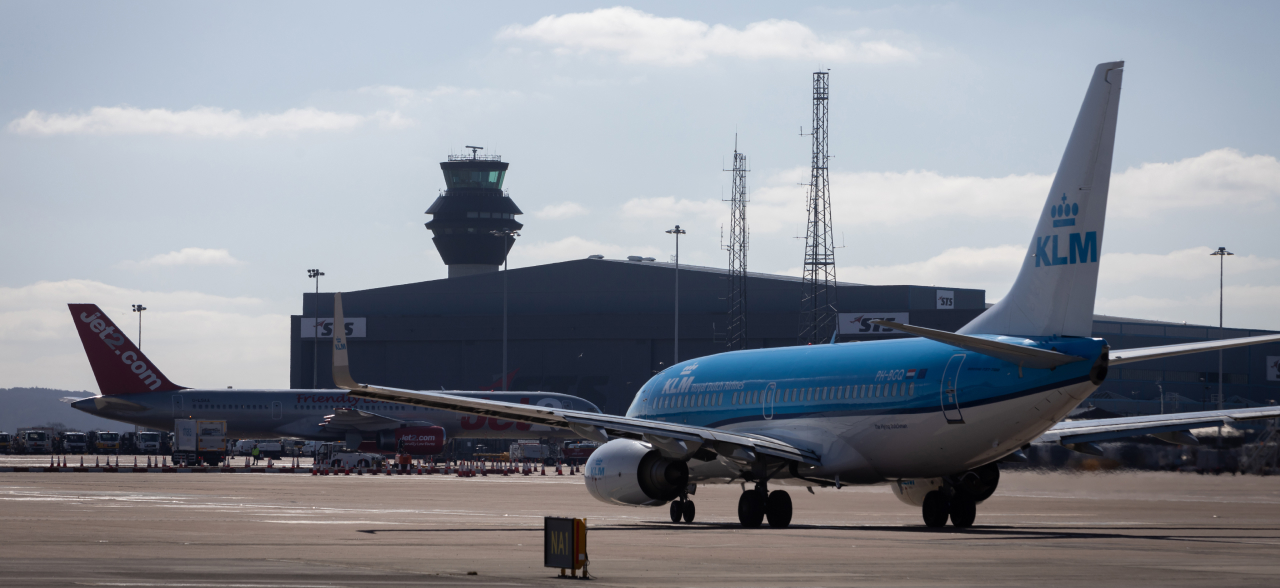
To ensure a safe take-off and landing, aircraft depart and arrive into the wind. On take-off, this helps produce the lift required to get airborne and landing into the wind enables a slower speed over the ground. The weather and wind direction can change and therefore the direction that the aircraft are arriving and departing may change to ensure the safest conditions to operate.
Air Traffic Control manages the runway direction for the safest aircraft operations. This includes consideration of the wind at ground level, 1000ft, and 2000ft, as well as the forecasted weather. Local weather forecasts only display wind strength and direction at ground level and this can differ at higher altitudes. Therefore local weather forecasts are not always a reliable indicator of the likely direction that aircraft will be operating.
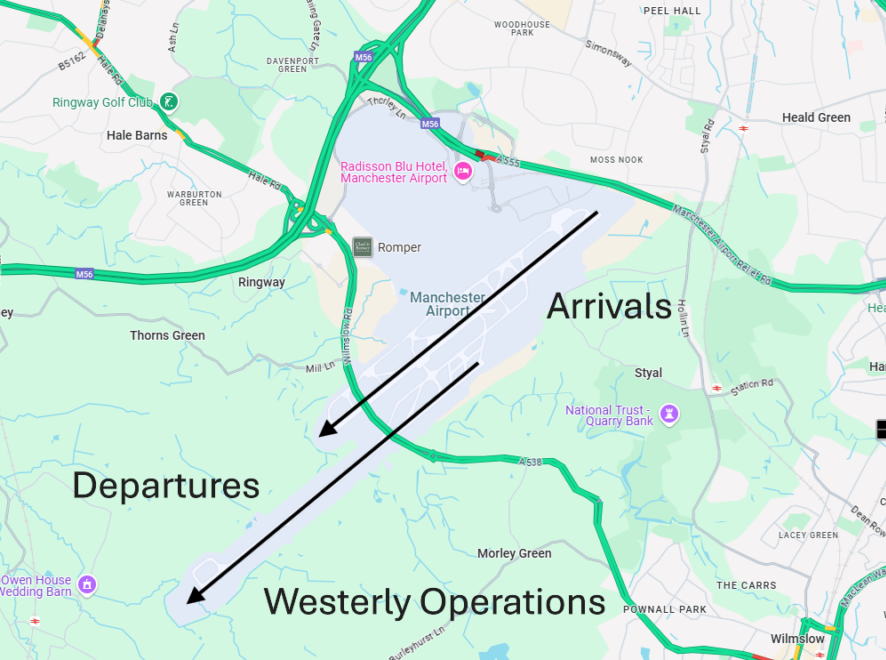
When the wind is blowing from west to east, the airport will operate in a westerly direction, known as “westerly operations” and the reverse during “easterly operations”. Experience of operations at Manchester Airport shows an average of over 80% of operations, each year, are westerly and the remaining operations in an easterly direction. The 80/20% split is an annual average and there are months with a much higher/lower proportion of westerly/easterly operations. An image demonstrating the direction of operations can be seen below:

Flight paths for arriving aircraft follow broadly similar patterns, unlike departures which are much more defined. The flight paths ensure separation from other air traffic and avoidance of adverse weather when necessary. This means that there may be variation in airport arrivals at different times of the day.
Aircraft arriving into Manchester Airport are transferred from the NATS area control centre to the Air Traffic Control approach controller, who sequences aircraft into an arrival pattern. They are then instructed where to fly by the Air Traffic Controllers, where they are directed towards their final approach before landing. When established on final approach to Manchester Airport, aircraft are transferred from the approach controller to the tower controller before landing.
To minimise the noise of approaching aircraft for communities near arrival paths, a ‘Continuous Descent Approach’ (CDA) is used when possible. Instead of a traditional descent whereby the aircraft reduces altitude in a stepped manner (similar to walking downstairs), they glide at a more constant rate (like an escalator). This keeps aircraft at a higher altitude for longer, minimising noise for local residents before an aircraft joins the ILS (the red shaded area in the image below), as well as providing benefits for fuel efficiency and reducing emissions. Operating a CDA is not always possible due to several factors such as congested airspace or adverse weather conditions which need to be avoided. With the Manchester Future Airspace project, we plan to facilitate changes that will make CDA easier to deliver. You can find out more about arrivals at Manchester Airport in the following video.

Departing aircraft move on the ground from their parking stands to the runway using taxiways. At the runway, they then await clearance from Air Traffic Control (ATC) to take-off. The weight of a departing aircraft can vary due to the amount of fuel, passengers, luggage, or cargo, and there can be a difference in the noise generated as the aircraft accelerates along the runway to become airborne.
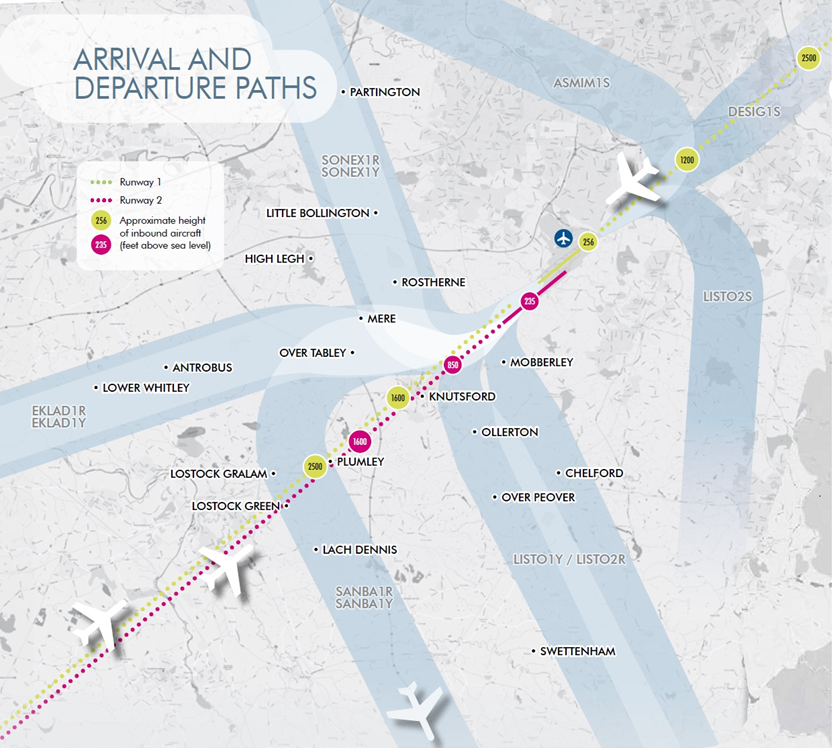
Depending on the aircraft’s destination, the departure will fly one of a number of departure routes (known as Noise Preferential Routes or NPRs). These routes are flown to minimise the overflight of local communities, whilst ensuring separation with other departures and surrounding air traffic, as well as optimising routing to the destination. The NPRs can be seen below. You can find out more about Manchester Airport Departures in the video above.

Aircraft must remain within the NPR until they reach a minimum altitude of between 3,000 to 5,000ft depending on the route, after which ATC can provide a more direct routing to the destination. For safety reasons, ATC may sometimes provide instruction to an aircraft to exit the NPR earlier to avoid adverse weather or other air traffic.
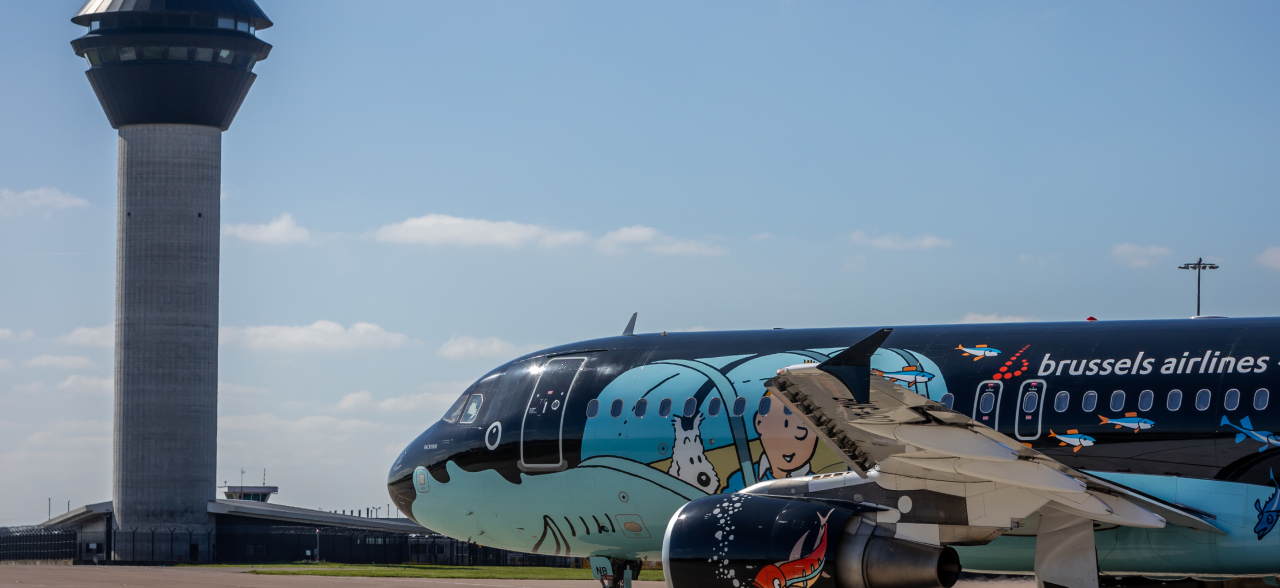
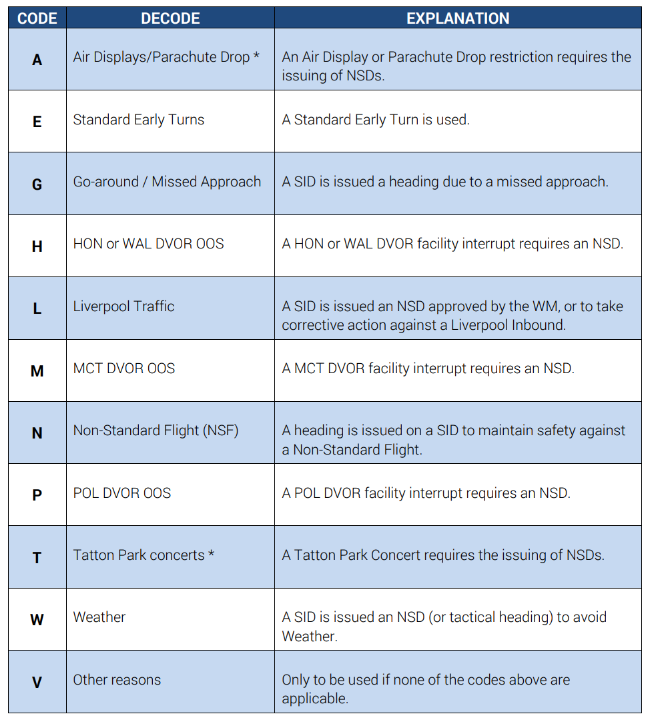
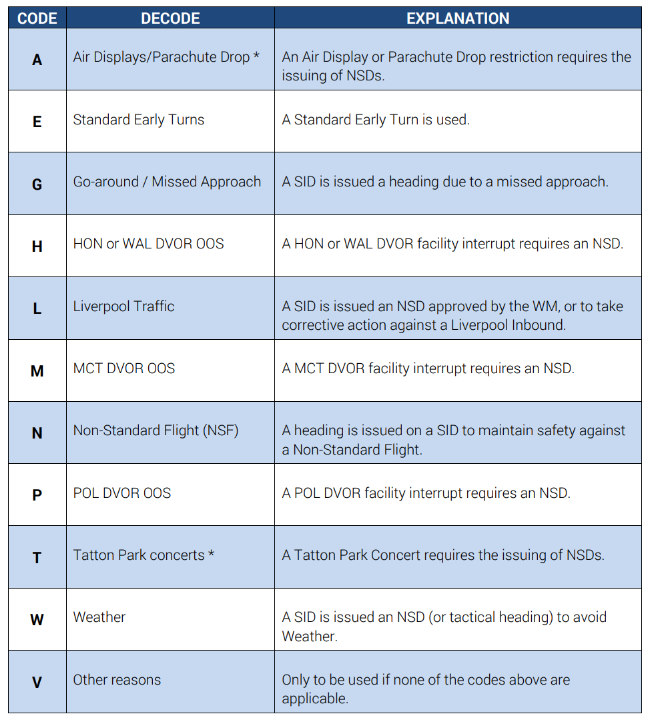
NSDs are special, alternative instructions given to aircraft by Air Traffic Control, which usually instruct an operator to fly outside the published noise preferential routes. These instructions are usually given prior to take off but can sometimes be given once the aircraft has left the runway. The reason for NSDs can vary as shown below, however NSDs will only be implemented when deemed necessary to maintain safe operations.
Possible reasons for NSDs:
Below is an example of an NSD due to weather from the 23L runway:

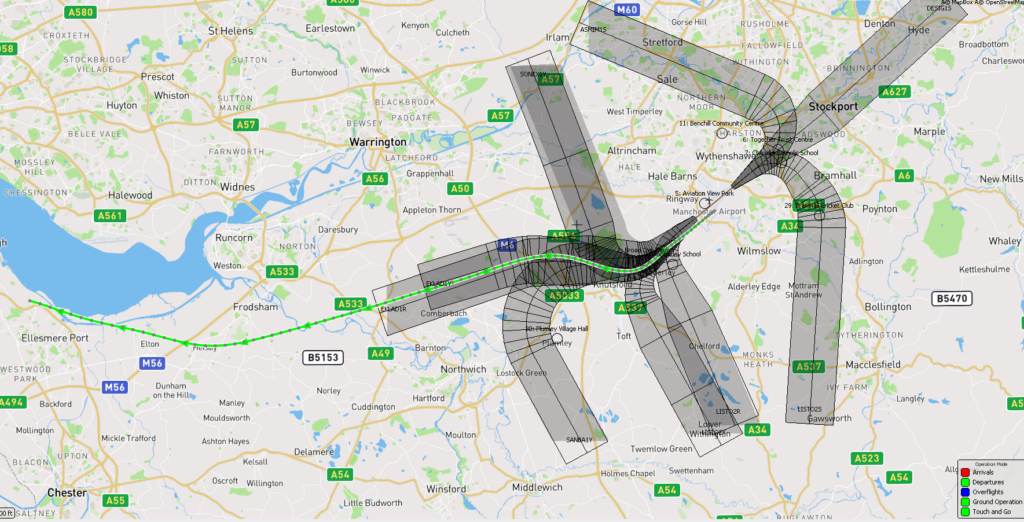
Below is an example of a departing aircraft following the EKLAD1Y off the 23L runway:
You can find out more by watching this video:
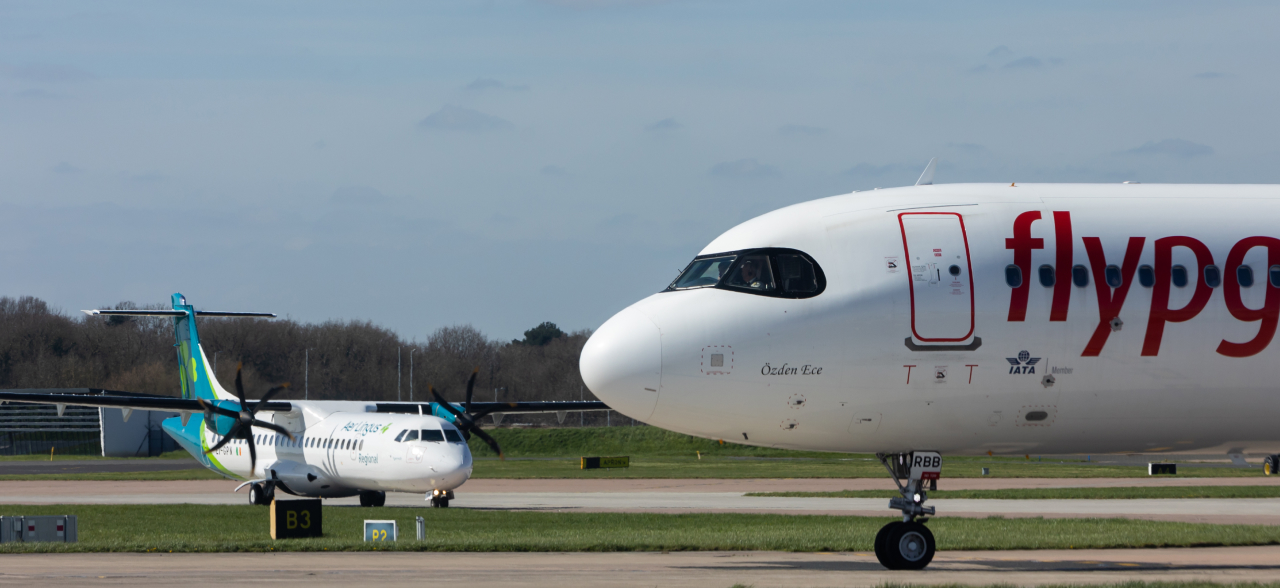
Runway 1 is closest to the terminal buildings. When we are using a single runway, aircraft land and depart from Runway 1. Air traffic control issue instructions so that only one aircraft is on the runway at a time. To create a more efficient operation, aircraft can be positioned on a nearby ‘taxiway’ waiting to enter the runway once the previous aircraft has either departed or has vacated the runway after landing.
Manchester Airport has two runways. Between 2001 and 2020 both runways were used during the daytime. Our planning permission does not allow us to use Runway 2 between 10pm and 6am, unless we are undertaking maintenance on Runway 1 or there is an emergency.
When we use Runway 1 and Runway 2, air traffic control use one runway for arrivals and the other for departures. This makes it simpler for air traffic control to manage arrivals and departures, and reduces delays in the air and on the ground.
Dual Runway Operation timetable for a typical winter period:
| Days | From the 1st November |
| Monday to Friday | 06:30-11:00 and 16:00-20:00 |
| Saturday | 06:30-11:00 |
| Sunday | 16:00-20:00 |
Dual Runway Operation timetable for a typical summer period:
| Days | From the 1st April |
| Monday to Friday | 06:15-20:00 |
| Saturday | 06:15-16:00 |
| Sunday | 06:15-09:30 and13:00-20:00 |
Reasons for the use of Runway 2 between 22:00 to 05:59
You can find out more by watching this video:

Every major commercial airport typically has set flight paths for departing aircraft from their runways. These are in place to maintain safety and whilst safety is always the number one priority, these routes are designed to minimise environmental impacts as much as possible in terms of fuel burn, emissions and noise impacts. However, airspace congestion and local weather, such as thunderstorms, may result in a large spread in flight paths. Arriving aircraft follow broadly similar patterns, which are not as defined as the flight paths for departing aircraft. Aircraft are directed by ATC to a position where they turn onto a runway heading (the direction of the runway that the aircraft will land on) before making its final approach. At Manchester Airport there is an Instrument Landing System (ILS) that guides the airport during its final approach to the runway.
The typical flight paths used at Manchester Airport are shown in the following interactive tool for both westerly and easterly operations. All data has come directly from our Aircraft Noise and Operations Monitoring System (ANOMS), which receives flight data from air traffic control radar. This system is operational 24 hours a day, 7 days a week, continuously tracking and recording aircraft flights to and from the airport. Flight tracks are recorded from radar data centred at the airport. The reason you will see radar tracks ending is because the extent of our radar coverage is 40nm (nautical miles).The graphic below shows arriving aircraft as red tracks with departing aircraft shown as green tracks.

As the world becomes more connected, there is a growing demand for air transport, which includes passenger and cargo connectivity around the world, into and out of different time zones. Not only does this make it easier for people to travel for holidays and to see friends and family, but it also helps businesses and the local economy by providing transportation links for time critical goods and services.
We recognise that night-time noise from aircraft operations is often the most intrusive. At Manchester Airport, the night period is defined as 23:30-06:00. Our night noise controls are intended to strike a balance between the economic and social benefits a thriving airport provides and the disturbance which can be caused by night flights.
Whilst night flights aren’t typically any louder than daytime operations, the background or ambient noise level can be lower, meaning an aircraft is more easily heard.
Aircraft Certification
Aircraft are certified by the International Civil Aviation Organisation (ICAO) according to the levels of noise they produce. Subsequently aircraft can then be classified separately for both take-off and landing depending on their certified noise levels, this is called Quota Count which assigns a value in terms of points .Points are allocated to different aircraft types according to how noisy they are. The noisier the aircraft type, the higher the points allocated. This provides an incentive for airlines to use quieter aircraft types.
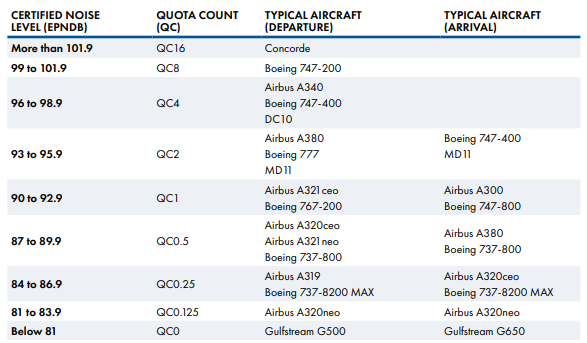
Manchester Airport has procedures in place to minimise the disruption caused by night flights. These procedures have evolved through consultation with local communities as part of the Noise Action Plan process. Aircraft with a QC8 or QC16 rating are prohibited during the hours of (23:00-07:00) due to their high noise levels. Additionally, there is a scheduling ban on QC4 aircraft during the core night (23:30-06:00). Furthermore, the possibility of implementing a scheduling ban for quieter QC2 aircraft is being explored to further minimize noise disruption.
More information can be found in our Noise Action Plan 2024-2028 and our night noise policy.
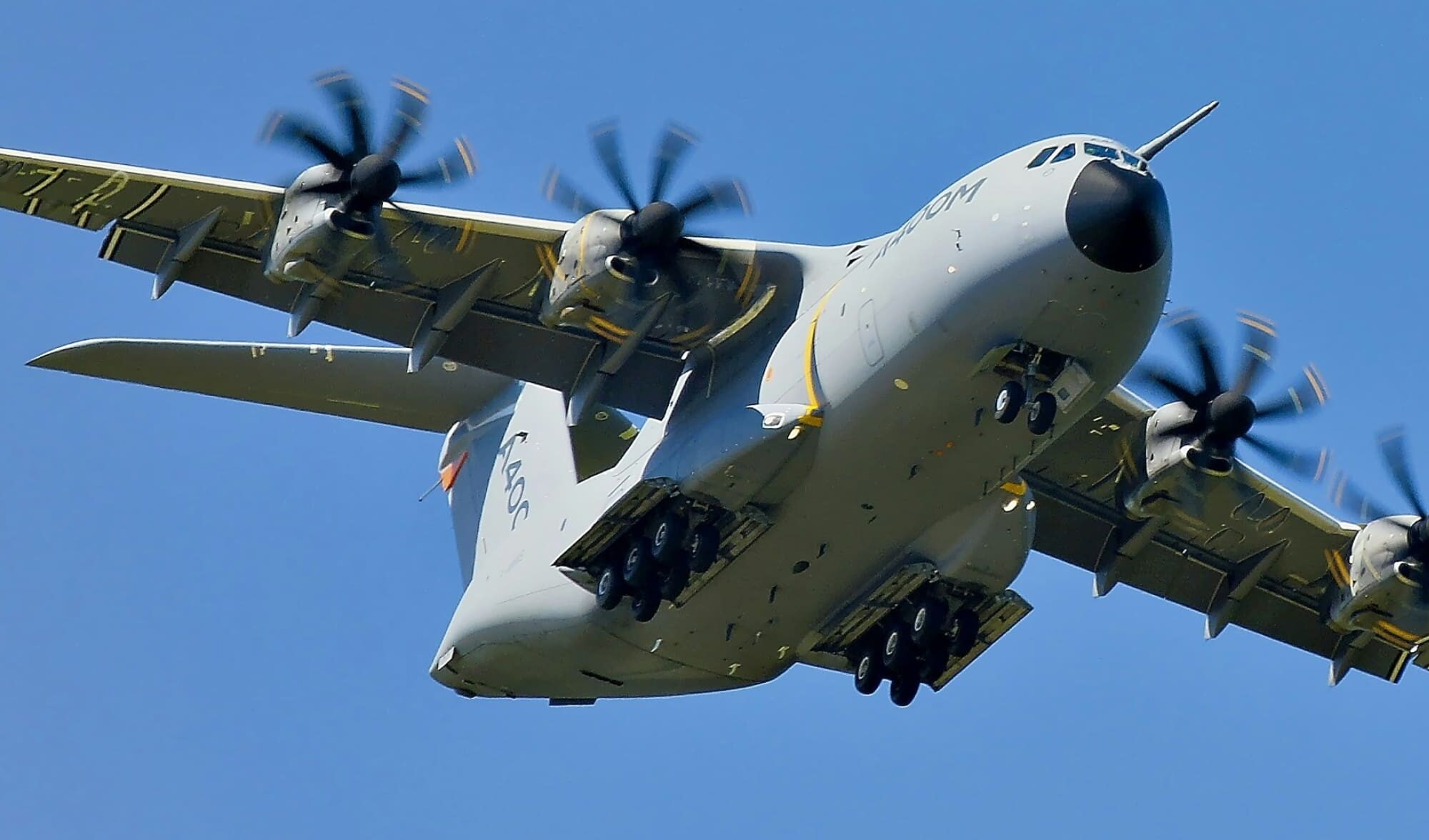
From time to time you may notice an unusual aircraft operation at or around the airport. Below are a number of examples of unusual operations that you may see at Manchester Airport.
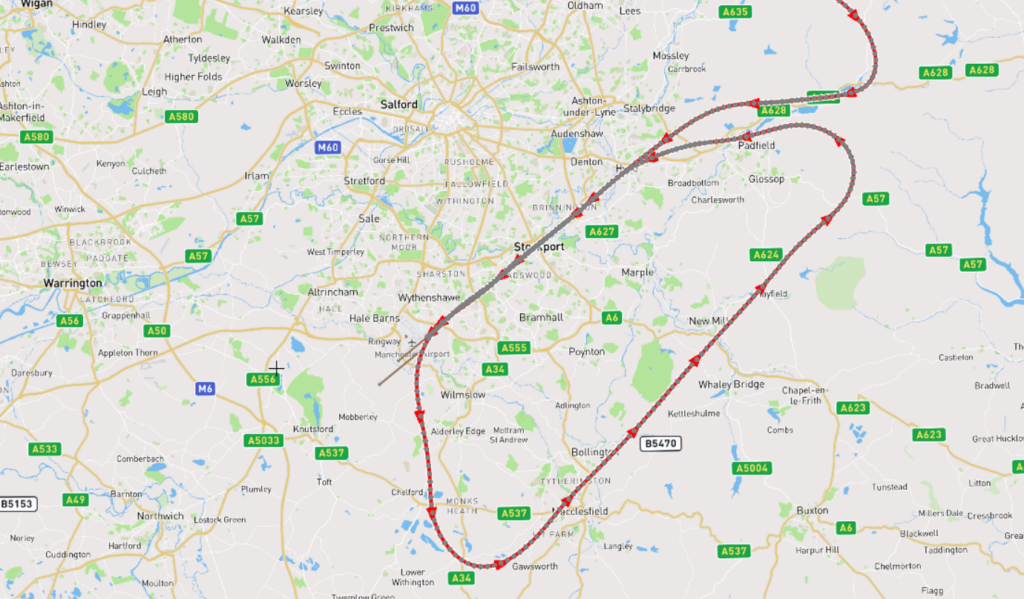
A go-around, or missed approach, can occur for many reasons such as, an obstruction on the runway preventing the aircraft from landing safely, a change in the wind conditions or that the aircraft cabin is not secure for landing. When coming into land, if a go-around is initiated, the pilot will apply thrust to climb straight ahead and then either turn left or right. Because a go-around can occur at any stage of the approach, the climb and turn could occur before or after reaching the runway. The exact path taken by an aircraft going around will be dependent on surrounding air traffic, the weather, the direction of operation and the point at which it is initiated.
The aircraft will take a wide orbit around the airport and then Air Traffic Control will then position the aircraft to make a second approach to the runway to land. This may mean that aircraft performing a go-around could overfly areas they do not normally at potentially lower than expected altitudes. Go-arounds are a rare occurrence at Manchester Airport.
An example of an aircraft undertaking a go-around when arriving on Runway 23R is shown below. As you can see the aircraft was instructed to take a left turn and then vectored around to re-establish for a second, successful approach to Runway 23R:
You can find out more by watching this video:
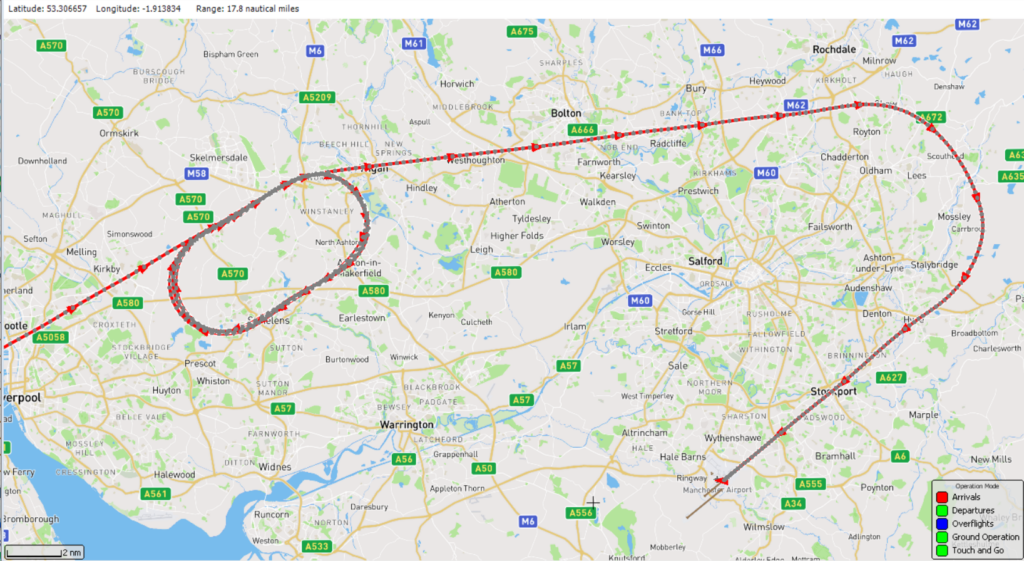
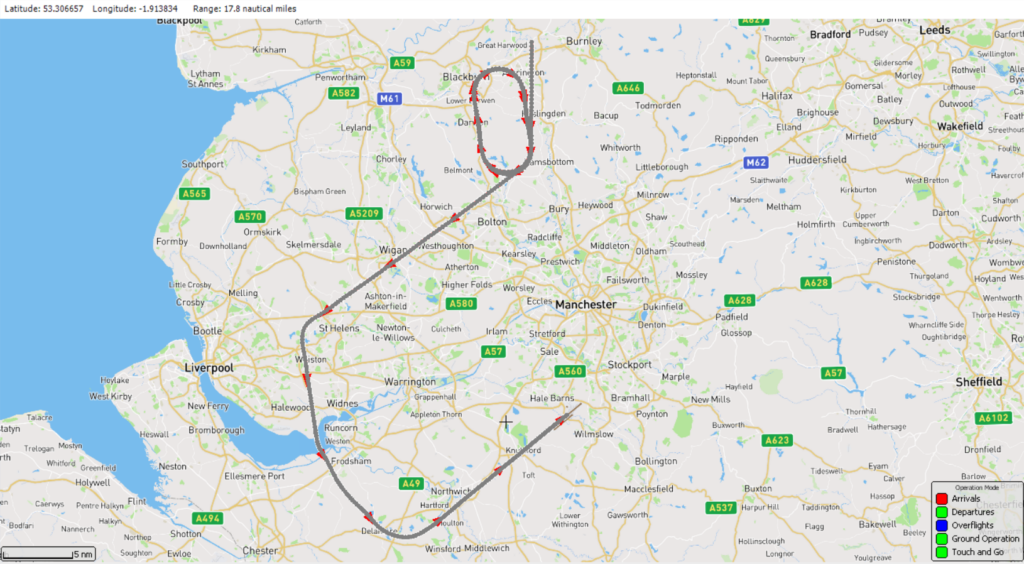
On occasion, often at busy times or during adverse weather, it will not be possible for aircraft to approach and land at Manchester Airport without having to be held for a short period of time. This takes place in fixed oval pattern known as a stack or hold.
Manchester Airport has three holding stacks; one called ‘MIRSI’ which is located over Winstanley, north of St Helens and the second, ‘ROSUN’ is located South East of Blackburn and the third, ‘DAYNE’ is located over Harpur Hill .
Here is an example of an aircraft in the MIRSI holding area-
Here is an example of an aircraft in the ROSUN holding area-
Here is an example of an aircraft in the DAYNE holding area-
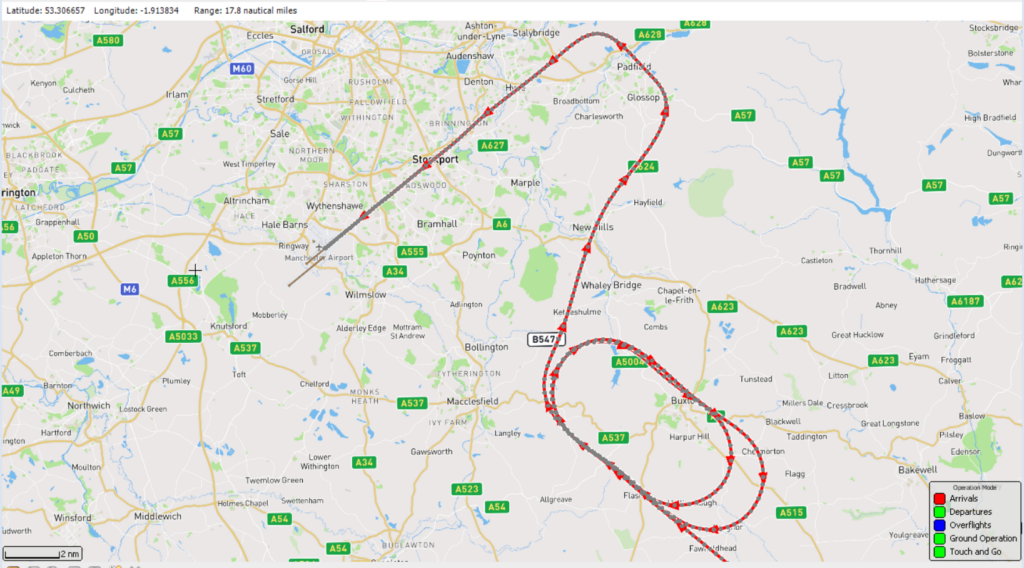
You can find out more by watching this video:
Most helicopters operating at Manchester Airport operate under ‘Visual Flight Rules’ and do not fly the Noise Preferential Routes (NPRs) when departing as commercial jet aircraft do. Similarly, helicopters do not arrive in the usual patterns seen with commercial jet aircraft. The pilot navigates using “visual” ground-based features such as roads and rivers etc. Examples of helicopter operations include Air Ambulances as well as helicopter operators passing through Manchester Airport controlled airspace.
NSDs are special, alternative instructions given to aircraft by Air Traffic Control, which usually instruct an operator to fly outside the published noise preferential routes. These instructions are usually given prior to take off but can sometimes be given once the aircraft has left the runway. The reason for NSDs can vary as shown below, however NSDs will only be implemented when deemed necessary to maintain safe operations.
Possible reasons for NSDs:
Copyright 2026. Manchester Airport plc. All Rights Reserved.
Powered by Ideagen