Night Flights
As the world becomes more connected, there is a growing demand for air transport, which includes passenger and cargo connectivity around the world, into and out of different time zones. Not only does this make it easier for people to travel for holidays and to see friends and family, but it also helps businesses and the local economy by providing transportation links for time critical goods and services.
We recognise that night-time noise from aircraft operations is often the most intrusive. At Manchester Airport, the night period is defined as 23:30-06:00. Our night noise controls are intended to strike a balance between the economic and social benefits a thriving airport provides and the disturbance which can be caused by night flights.
Whilst night flights aren’t typically any louder than daytime operations, the background or ambient noise level can be lower, meaning an aircraft is more easily heard.
Aircraft Certification
Aircraft are certified by the International Civil Aviation Organisation (ICAO) according to the levels of noise they produce. Subsequently aircraft can then be classified separately for both take-off and landing depending on their certified noise levels, this is called Quota Count which assigns a value in terms of points .Points are allocated to different aircraft types according to how noisy they are. The noisier the aircraft type, the higher the points allocated. This provides an incentive for airlines to use quieter aircraft types.
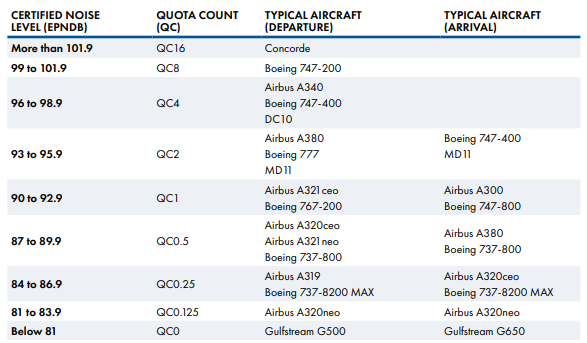
Manchester Airport has procedures in place to minimise the disruption caused by night flights. These procedures have evolved through consultation with local communities as part of the Noise Action Plan process. Aircraft with a QC8 or QC16 rating are prohibited during the hours of (23:00-07:00) due to their high noise levels. Additionally, there is a scheduling ban on QC4 aircraft during the core night (23:30-06:00). Furthermore, the possibility of implementing a scheduling ban for quieter QC2 aircraft is being explored to further minimize noise disruption.
More information can be found in our Noise Action Plan 2024-2028 and our night noise policy.